Trump’s tariffs have captivated the current news cycle and bear major ramifications for the cost of goods, global supply chains, and America’s influence in the world. The goal of his policy is to narrow America’s trade deficit, which he calls a “national emergency”.
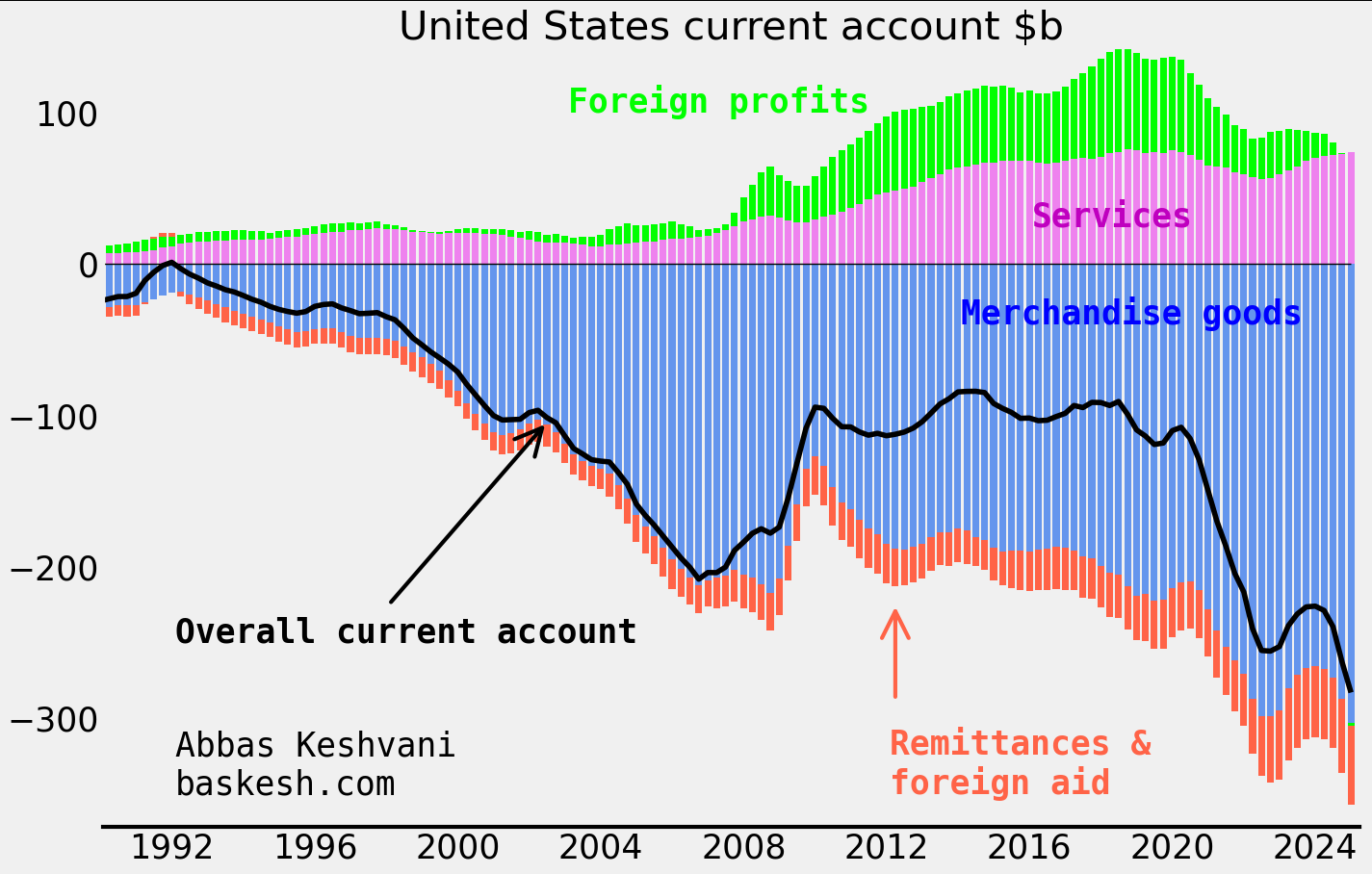
A gaping goods deficit. America experienced its first modern goods deficit in 1971, a product of the postwar industrial revival in Europe and Japan. Since then, US demand for foreign merchandise like cars and electronics have ballooned the deficit to $1.2 trillion or 3.7% of GDP in 2024. The goods deficit (blue in the below chart) dwarfs America’s surplus from services, like management consulting and software licenses. Aside from goods, other sources of outflows like foreign aid are also being targeted by Trump scaling back on America’s defense commitments.
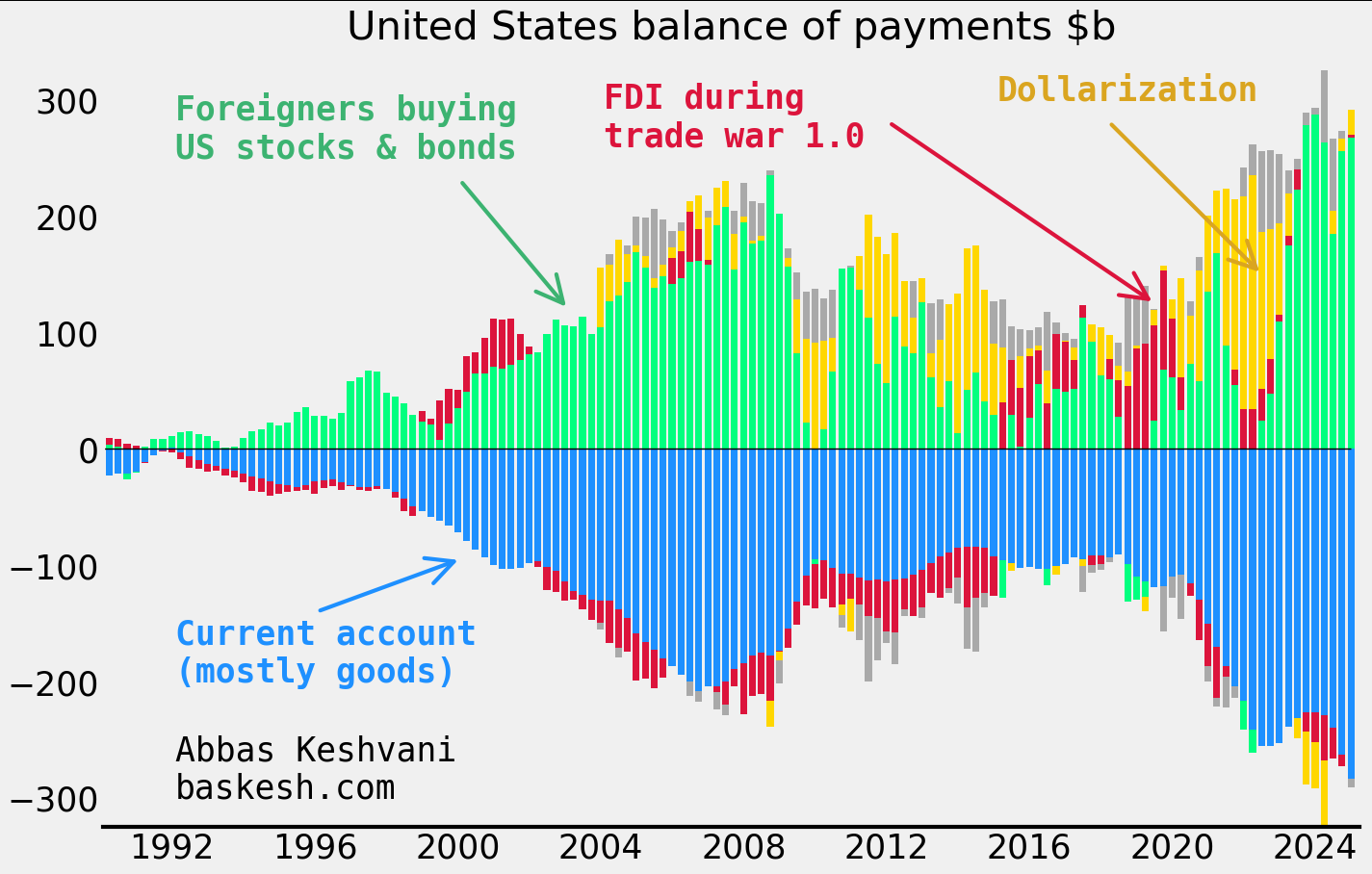
The money does come back eventually… The outflows from America’s goods deficit generally return back to the country via inbound foreign portfolio investment. As a result, the Chinese own 2.8% of outstanding US Treasuries, Koreans own 1.5% of Tesla stock, and so on… We can see this in America’s balance of payments (BOP), which tracks all cross-border flows, visualized in the next chart. US BOP essentially comprises of a wide current account deficit (blue) and large foreign inflows into American stocks and bonds (green).
… But not everyone likes this deal. The administration does not consider America’s BOP dynamic — a current account deficit funded by financial inflows — to be a healthy state of affairs. Robert Lighthizer, the architect of the trade war in the first Trump presidency, describes it as a transfer of wealth to foreigners: “aggressors now own both those assets and the future income of a large segment of the U.S. economy”.
What about industrial policy? There are other ways to tackle the good deficit. Tariffs seek to hamper imports. Meanwhile, “industrial policy” or government support of strategic sectors can be used to support exports. But industrial policy, which requires a strong centralized government like China’s, is tricky under America’s fractious political system.
What about a weaker dollar? Another option is to try to weaken the dollar, which would simultaneously support exports and stymie imports. But currency devaluation would carry major geopolitical ramifications for Washington. In any case, whether it is intentional or not, Trump is already pursuing a weaker dollar policy by demanding the Fed cut rates.
Around the same time that the United States experienced its first modern goods deficit in 1971, Nixon upended the international monetary order. He halted the international convertibility of dollars for gold and engineered a devaluation of his currency against those of Germany and Japan. Today’s goods deficit is significantly larger, both in nominal terms and as a share of GDP. It will probably remain a key focus for the White House.
Data from US Bureau of Economic Analysis. Charts produced on Python.

 CoolStatsBlog